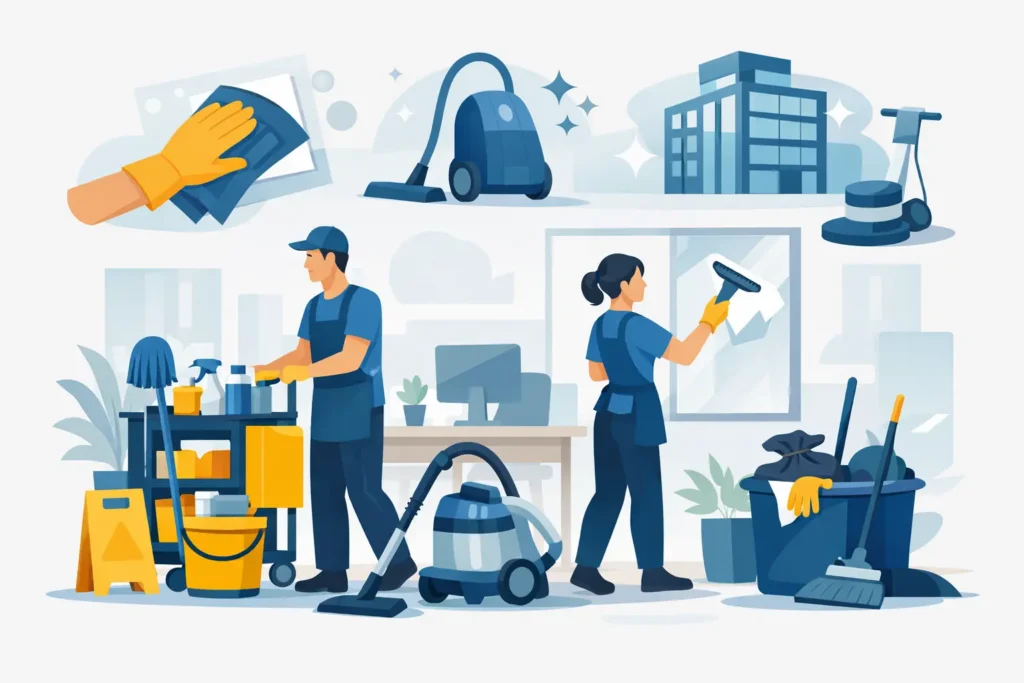
If you’ve ever asked what is included janitorial services, you’re usually not looking for a textbook definition. You want to know what will actually get cleaned, how often it gets done, and whether the service will keep your site presentable without constant follow-up. That matters whether you’re managing an office, a clinic, a retail space or a residential building with shared areas.
Janitorial services are generally designed for ongoing upkeep rather than one-off intensive cleaning. The goal is to maintain a clean, hygienic, orderly environment through scheduled visits. In practice, that means the scope can be broad, but it is rarely identical from one site to the next. The right answer depends on your building, foot traffic, industry requirements and the standard you need to maintain.
What is included in janitorial services?
At its core, janitorial cleaning covers the routine tasks that stop a workplace or shared facility from slipping into mess, odour and hygiene issues. These are the jobs that need doing daily, several times a week, or on a regular roster to keep operations running smoothly.
Most janitorial services include emptying bins, replacing bin liners, wiping surfaces, dusting accessible areas, vacuuming carpets, mopping hard floors, spot-cleaning marks, cleaning kitchens or tea rooms, and sanitising bathrooms. In many settings, cleaners will also restock basic consumables such as toilet paper, hand soap and paper towels if those supplies are provided on site or included in the agreement.
This is the part many people miss: janitorial work is not just about appearance. It also supports hygiene, staff comfort, client perception and risk reduction. A clean reception area looks professional, but a properly maintained bathroom, lunchroom and touchpoint schedule can also reduce complaints and help create a healthier environment.
The day-to-day tasks most sites need
Routine janitorial work usually starts with visible essentials. Floors are vacuumed or mopped, rubbish is removed, desks or counters are wiped where agreed, and high-use areas are straightened and cleaned. Entry points often get extra attention because they collect dust, debris and first impressions at the same time.
Bathrooms are a major part of the service. That typically includes cleaning toilets, urinals, basins, mirrors, taps and partitions, then disinfecting contact points and mopping floors. In busy commercial sites, bathroom cleaning may need to happen more than once a day, especially if the building has high visitor traffic.
Kitchenettes and staff break areas are another regular inclusion. Benches, sinks, splashbacks, appliance exteriors and tables are commonly cleaned, with bins emptied and floors mopped. Some providers will also clean inside microwaves and fridges as part of routine service, while others treat that as a periodic extra. That difference is worth clarifying early.
General touchpoint cleaning has become more important in recent years. Door handles, light switches, lift buttons, shared phones, handrails and other frequently handled surfaces may be included in a standard janitorial schedule, particularly in offices, medical settings and public-facing businesses.
What janitorial services often include by area
The easiest way to understand scope is by space rather than by task list alone.
In office areas, janitorial cleaners usually focus on floors, rubbish, desks or workstations if accessible, meeting rooms, shared equipment surfaces, reception counters and glass partitions at touch height. In client-facing spaces, presentation matters just as much as sanitation, so smudge-free surfaces and tidy floors are a priority.
In bathrooms, the expectation is more intensive. Cleaners normally disinfect fixtures, polish mirrors, restock consumables, remove rubbish and address odour control. If standards slip here, the whole site feels neglected.
In kitchens and lunchrooms, the service often includes sanitising benches, wiping cupboard fronts, cleaning sinks, removing rubbish and mopping floors. Food preparation areas may need stricter processes depending on the type of business.
For common areas such as lobbies, corridors, lifts and stairwells, janitorial cleaning usually covers floor care, dusting ledges, spot-cleaning marks on walls or glass, and keeping the space free of clutter and rubbish. In strata or multi-tenant buildings, these shared zones are often the heart of the janitorial schedule.
What may not be included
This is where confusion happens. Clients hear “janitorial” and assume it covers everything from ceiling vents to carpet restoration. Usually, it doesn’t.
Most standard janitorial agreements do not automatically include deep cleaning, external window cleaning, pressure washing, high-access cleaning, mould treatment, specialised floor stripping and sealing, or post-construction clean-up. These services often require different equipment, more time, extra safety controls or a separate quote.
Consumables can also sit in a grey area. Restocking may be included, but the actual supply cost of toilet paper, soap, bin liners and paper towels might be billed separately. The same applies to sanitary bin services or specialised waste disposal.
There are also limits around personal or sensitive spaces. In offices, cleaners may not move confidential paperwork, valuables or unsecured electronics. In medical environments, there may be strict boundaries around clinical waste, treatment rooms or infection control procedures unless the team is specifically trained for that setting.
Why the scope changes from one site to another
A small office with ten staff needs a different janitorial plan from a childcare centre, gym or medical clinic. The daily build-up of dirt, moisture and bacteria simply isn’t the same. That’s why a good provider won’t rely on a one-size-fits-all checklist.
Frequency is one of the biggest variables. Some premises need cleaning every evening. Others only need three visits a week, or a mix of daily bathroom servicing with less frequent full cleans. If your building has heavy foot traffic, customer-facing areas or shared amenities, lighter schedules can quickly become false economy.
Timing matters too. After-hours cleaning is common for offices and retail, while some facilities need daytime janitorial support so issues can be addressed as they happen. Think spills, washroom upkeep, touchpoint sanitising and bin overflow during trading hours.
What to expect from a professional janitorial provider
A reliable janitorial service should offer more than a cleaner with a mop and key access. You should expect a clear scope of work, agreed frequencies, consistent standards and a team that turns up when scheduled. That reliability is what separates a professional service from a stop-start arrangement that creates more admin than it saves.
Good providers also pay attention to site-specific requirements. That may include security procedures, alarm access, infection control expectations, preferred products, quiet cleaning around staff, or reporting maintenance issues such as leaking taps or low consumables.
Training and vetting matter as well. If cleaners are entering your workplace regularly, trust is part of the service. Police-checked staff, proper induction and quality control processes can make a real difference, especially for offices, healthcare settings and managed properties.
How to tell if the quote covers what you need
The simplest way to avoid mismatched expectations is to look past the headline price and read the scope carefully. A cheaper quote can still cost more in complaints, missed tasks and emergency call-backs if key areas are excluded.
Ask whether bathrooms, kitchens, touchpoints, internal glass, consumable restocking and spot cleaning are included. Check how often each area will be serviced and whether there are any exclusions tied to time limits, access restrictions or special surfaces. If your premises have carpet tiles, polished floors, medical rooms or high-use amenities, those details should be spelled out rather than assumed.
It also helps to ask how quality is managed. If a task is missed, what happens next? A professional provider should be able to explain their communication process, inspection standards and how they handle re-cleans or service issues.
Janitorial services vs deep cleaning
Janitorial cleaning keeps a site under control. Deep cleaning resets areas that need more intensive attention. Both are useful, but they serve different purposes.
If your floors are maintained, bins are emptied, bathrooms are sanitised and surfaces are wiped on schedule, that’s janitorial work. If you’re removing built-up grime from grout, detailing skirting boards, cleaning vents, washing walls or tackling neglected areas, that’s closer to a deep clean.
Many businesses need both. Regular janitorial service maintains standards, while periodic deep cleaning lifts the overall condition and addresses the gradual build-up that routine visits can’t always cover in full.
For Adelaide businesses and property managers, that balance often delivers the best result – a regular schedule for consistency, with occasional intensive work where needed. It’s practical, easier to budget for, and far less disruptive than waiting until the site looks tired.
The best janitorial service is not the one with the longest checklist. It’s the one with a clear scope, dependable staff and a routine that fits how your space is actually used. When the service matches the site, cleaning stops being something you chase and starts being one less thing to worry about.