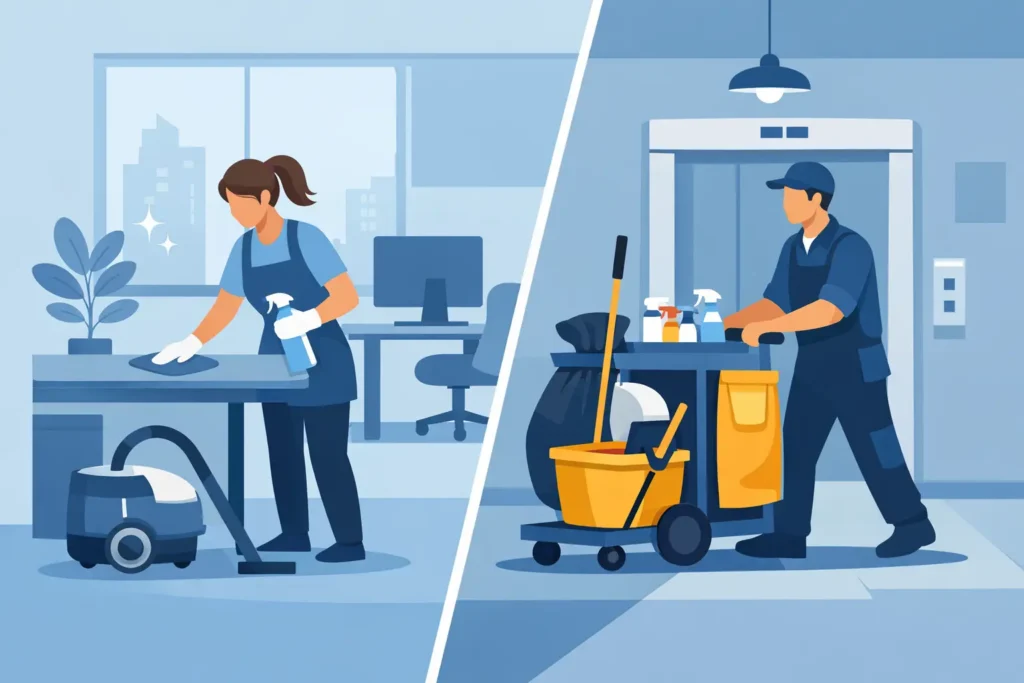
If you are comparing office cleaning vs janitorial services, you are probably not looking for theory. You want to know what you are actually paying for, what your workplace needs, and whether one option will leave you chasing missed bins, smudged glass, or toilets that should have been checked hours ago.
The confusion is understandable because the two terms are often used interchangeably. In practice, they can mean very different service models. One is usually built around scheduled cleaning tasks completed at set times. The other often includes ongoing day-to-day maintenance support that keeps a site presentable and hygienic while people are using it.
Office cleaning vs janitorial services: what is the difference?
The simplest way to look at it is this. Office cleaning usually refers to planned cleaning carried out after hours, before opening, or at agreed intervals through the week. Janitorial services usually refer to more routine, ongoing site upkeep that supports the day-to-day operation of a workplace.
That does not mean office cleaning is limited or that janitorial services always involve a cleaner being on-site all day. Service scope varies from provider to provider. But in most commercial settings, office cleaning is task-focused, while janitorial services are maintenance-focused.
An office cleaning service commonly covers vacuuming, mopping, wiping desks and surfaces, sanitising kitchens and bathrooms, emptying rubbish bins, and cleaning shared areas such as meeting rooms and reception spaces. These tasks are usually completed in one visit, whether that is nightly, several times a week, or weekly.
Janitorial services often include many of those same tasks, but with an operational layer added in. That may involve restocking consumables, spot-cleaning spills during business hours, checking bathrooms multiple times a day, removing rubbish before it overflows, keeping entry points tidy, and responding to mess as it happens rather than waiting for the next scheduled clean.
Where office cleaning makes the most sense
For many Adelaide businesses, office cleaning is the right fit because the workplace simply does not need constant attention. A professional office with a stable number of staff, moderate foot traffic, and standard amenities can often be kept in excellent condition with a well-structured recurring clean.
That is especially true for smaller offices, professional suites, consulting rooms with low visitor traffic, and businesses that operate mostly during standard weekday hours. In these environments, a reliable cleaner can come in after hours, complete the agreed scope thoroughly, and leave the site presentation-ready for the next day.
The benefit here is efficiency. You know when the service happens, what tasks are included, and what standard should be maintained. It is also usually more cost-effective than a broader janitorial arrangement because you are not paying for as much active oversight across the day.
That said, office cleaning works best when the site stays reasonably controlled between visits. If your kitchen is in constant use, your bathrooms get heavy traffic, or clients are coming and going all day, one evening clean may not be enough to maintain the standard you want.
When janitorial services are the better choice
Janitorial services are better suited to workplaces that need regular touchpoints, not just one completed clean. Think larger offices, medical settings, schools, gyms, retail spaces, shared commercial buildings, and any site where cleanliness affects customer impression, staff comfort, or compliance.
In those environments, mess builds up during operating hours. Bathrooms need checking before they become a problem. Soap, paper towel, and toilet paper need replenishing. Spill response matters. Rubbish can become a visual issue long before the end of the day. If your team notices cleaning problems while the business is still open, that is often a sign you need janitorial support rather than a standard office clean alone.
There is also a practical staffing advantage. Janitorial services create accountability for those smaller but important maintenance tasks that otherwise fall to reception staff, admin teams, or managers. That keeps your people focused on their actual job instead of chasing cleaning issues around the workplace.
The overlap that causes confusion
Part of the reason this topic gets muddy is that many cleaning companies offer both services and may describe them differently. One provider might call a nightly office clean a janitorial service. Another might reserve the term janitorial for daytime support only. A third might package everything under commercial cleaning.
That is why labels matter less than scope. A better question than “Do you offer janitorial?” is “What exactly is included, how often is it done, and who checks the site between full cleans?”
This is also where clear quoting becomes important. A low quote may look attractive until you realise it covers only one quick clean after hours, with no restocking, no spot cleaning, and no attention during peak use. On the other hand, some businesses overpay for a level of service they do not truly need.
How to choose between office cleaning and janitorial services
Start with how your workplace actually functions, not how you describe it. A ten-person office open from 8:30 to 5 with low visitor traffic has different needs from a busy showroom, a clinic, or a multi-tenant building.
Look at foot traffic first. The more people moving through a space, the faster bathrooms, floors, kitchens, and entry points deteriorate. Then look at presentation risk. If clients, patients, tenants, or guests regularly see your space, standards need to hold up all day, not just first thing in the morning.
Next, consider hygiene sensitivity. In a medical, health, childcare, or food-adjacent environment, waiting until the end of the day to deal with bins, spills, or high-touch points may not be enough. Janitorial support can help maintain safer, more consistent conditions.
Then there is internal capacity. If your staff are already replacing hand towels, wiping break room benches, or dealing with overflowing bins, the cleaning model is not matching the reality of the site. A proper service arrangement should remove that friction, not create it.
Questions worth asking before you book
If you are comparing providers, ask for specifics. How often are bathrooms cleaned or checked? Are consumables restocked? Is rubbish removal included beyond bin emptying? Can they handle daytime touch-ups? Are staff trained, vetted, and consistent from visit to visit?
It is also worth asking how quality is managed. Commercial cleaning is not just about whether a checklist exists. It is about whether standards are repeatable. Reliable providers build systems around communication, site instructions, trained staff, and follow-up when something needs attention.
That matters just as much as the cleaning itself. A service that looks fine on paper but changes staff constantly or leaves you chasing updates can create more work than it saves.
It is not always one or the other
Some businesses do best with a hybrid approach. They may have scheduled office cleaning after hours, plus light janitorial support during the day on busy days or in high-use areas. That can be the most practical option for growing businesses, shared spaces, and workplaces with uneven demand across the week.
For example, an office may only need a full clean three evenings a week, but still benefit from daytime bathroom checks and consumable restocking Monday to Friday. A healthcare site may need daily detailed cleaning plus more frequent support around reception, treatment rooms, or common areas.
This is where a tailored scope is far more useful than picking a label. The right service should fit your operations, your traffic levels, and the standard you want your staff and visitors to experience.
The real decision is about consistency
When people compare office cleaning vs janitorial services, they often think they are choosing between two similar names. In reality, they are choosing how their workplace will be maintained when life gets busy.
If a scheduled clean is enough to keep your office fresh, hygienic, and professional, that may be all you need. If your site needs attention across the day, janitorial support can prevent small issues becoming visible problems. Neither option is automatically better. The right one depends on how your space is used, how often standards slip between cleans, and how much peace of mind you want built into the service.
For businesses that value reliability, clear communication, and cleaning that actually matches the way the site operates, the smartest choice is usually the one that feels almost invisible – because everything is simply handled, every time.